SELF-INITIATED UX STUDY • 2025
KnockKnock
A concept for people who've just relocated, or those who are stretched too thin for their usual social circle, to discover and host small, local get-togethers.
This is a self-initiated concept project. It was not created for, commissioned by, or affiliated with an existing product or organization.
At a glance
- MY ROLE
- UX research, & design
- TOOLS
- Pen & paper, Figma
- SCOPE
- Mobile flow, Responsive web experience
- RESOURCES & LINKS
- Figma Prototype (Mobile Flow) Figma Prototype (Desktop Flow)
01 / CONTEXT
The opportunity
I've relocated for school about six times over the years & every time, building a social circle from scratch was one of the hardest parts. Conversations with friends & family who'd relocated shared this sentiment. It wasn't a lack of interest in socializing, rather it was not knowing where to start, having no social circle to lean on, and struggling to find activities that felt low-stakes enough to show up to alone. This is a pattern I've observed through my own experience & conversations.
Design question
How might we help someone with no existing social network in a new city discover and join small, local social activities, without it feeling like showing up to a stranger's party alone?
02 / DISCOVERY
Learning before making
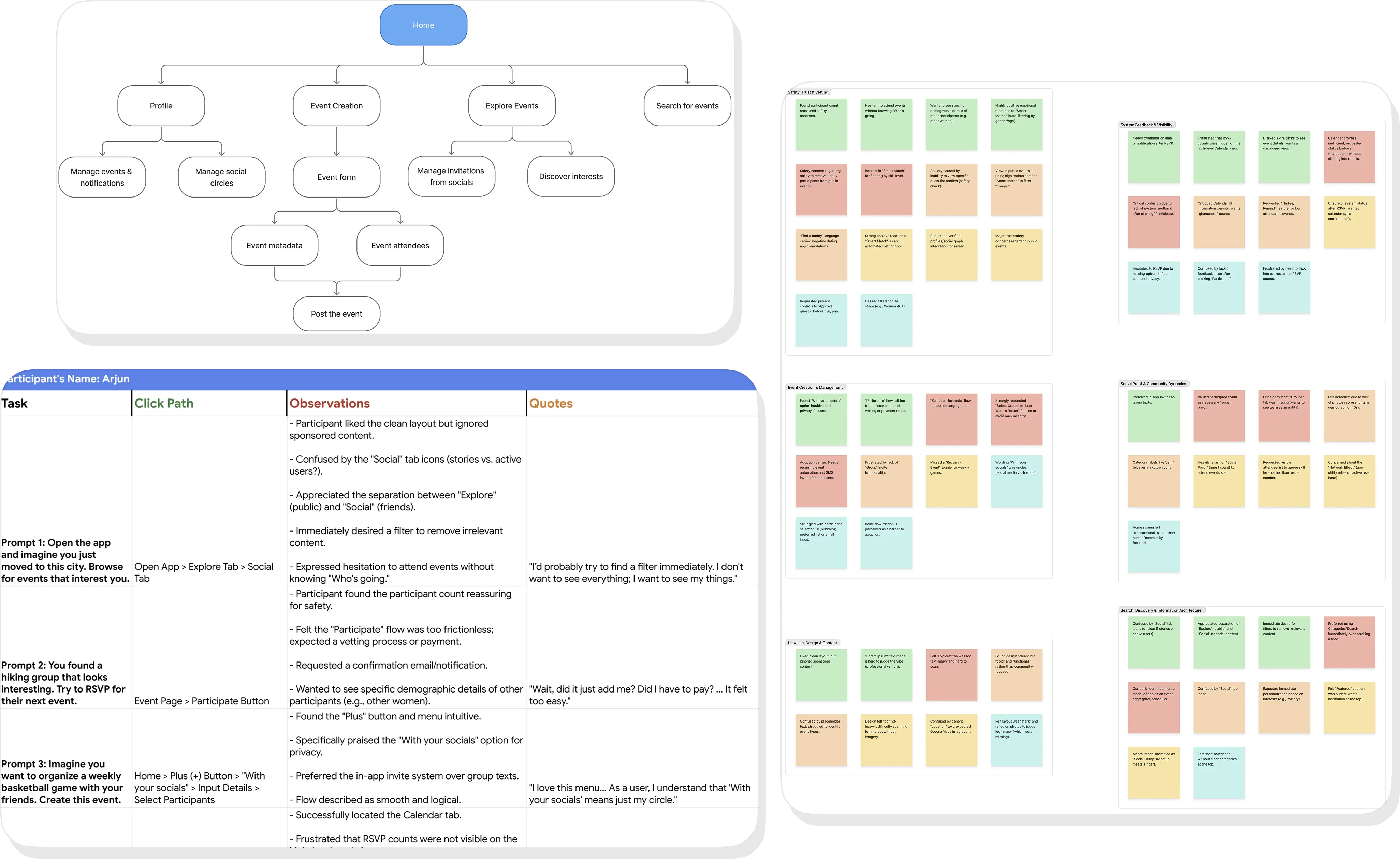
To check this pattern against more than just my own experience, I had informal conversations with four friends and family members who'd relocated for work in the past few years. This wasn't a structured study, & a next step would be a proper round of interviews with a wider, less convenience-based group.
What I learned
- Newcomers don't lack interest in socializing, rather they lack a low-stakes way in. People described feeling intimidated joining an established group alone, even when the activity itself appealed to them.
- Big, paid, ticketed events felt like the wrong fit. Smaller, recurring activities, like a weekly soccer match or a cycling group, felt more approachable and more likely to lead to an actual connection than a one-off ticketed event.
- Knowing who else is going matters more than the activity itself. Hesitation was less about whether the event sounded fun and more about walking in without a single familiar face.
03 / DIRECTION
Turning insights into a focused concept
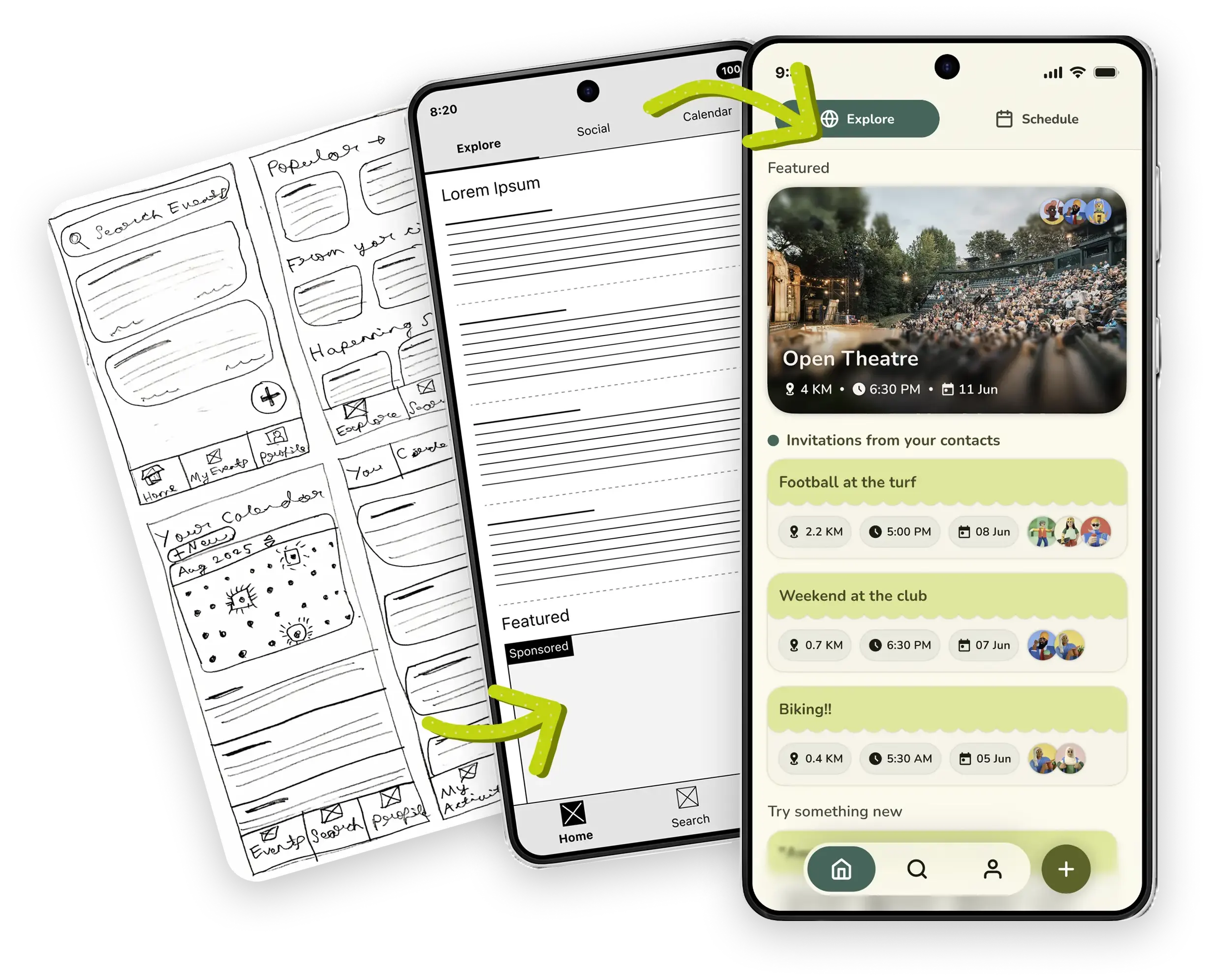
The initial iteration was trying to take on a lot at once, making its proposed solutions feel shallow. Users are already accustomed to existing social media platforms, & trying to draw in in-app messaging into an event organizing app would cause friction. Online event hosting isn't something a lot of users are familiar with, & it was pertinent to make the creation flow as welcoming as possible to ensure that users wouldn't drop off mid way. Social proof remains the non-negotiable proof that users will need to verify that events are not spurious, and that its worth their time & effort.
Design principles
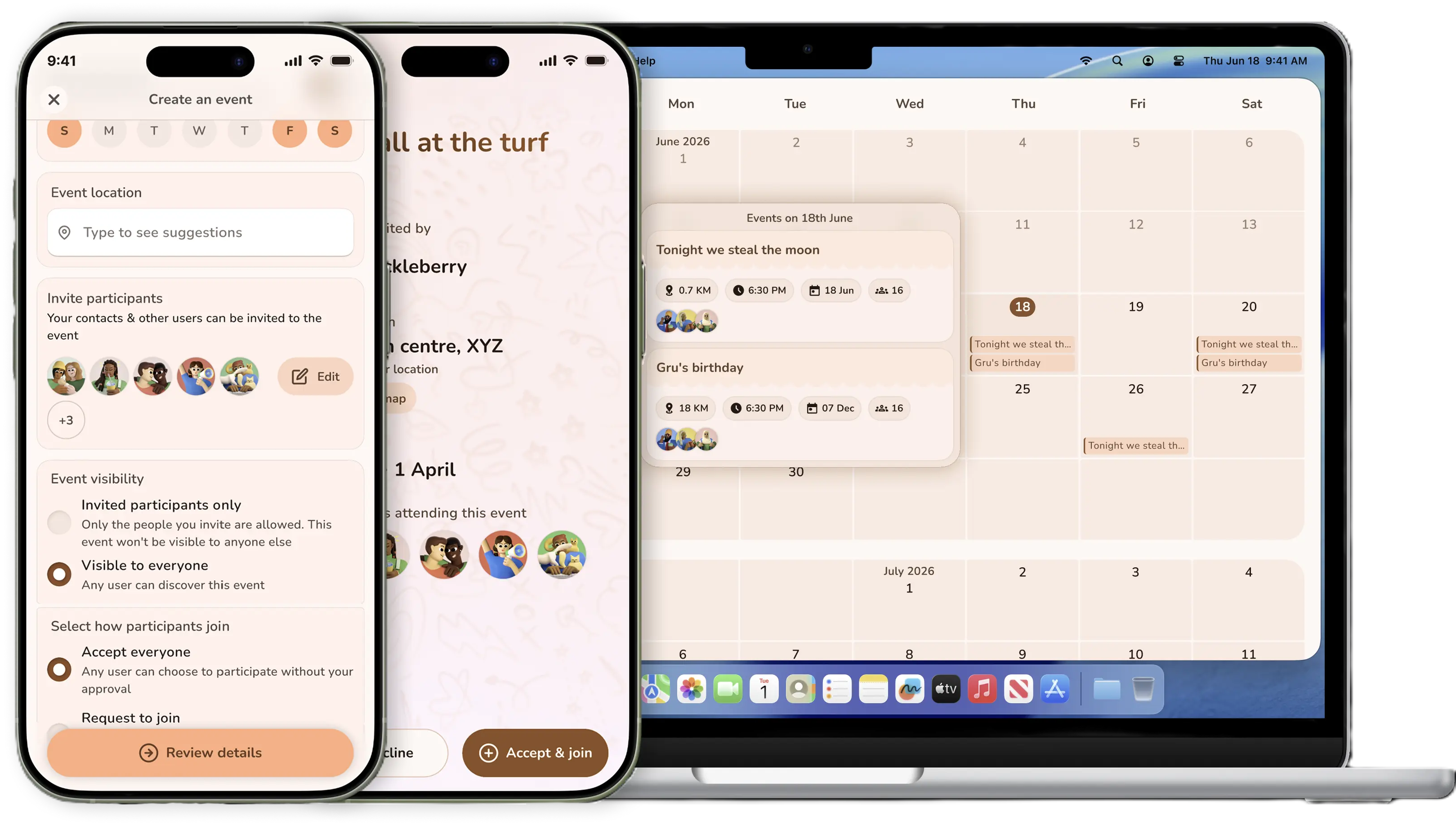
- Leading with intent: The event creation form covers a lot of ground — visibility, join approval, event recurrence, participant caps. The form uses the tried & tested pattern of progressive disclosure to avoid overwhelming the user; weekday selector remains hidden unless the user opts to make the event recurring, join approval options are not shown unless the user opens the event up for everyone. The form items were tuned to be relevant to the user's needs through several iterations, while also seamlessly surfacing the intent behind every option.
- Knowing its place: The first iteration included a "Socials" tab for in-app messaging. It was then dropped, since people already have a messaging platform they trust, and trying to pull that behavior into an event discovery app would have added friction rather than reducing it. Users instead asked for wasy to share invite links to other apps, or via email. The app stays focused on discovery, scheduling, & hosting.
- Letting other people vouch: Asking someone to trust an unfamiliar host is a big ask. Surfacing contacts who are already attending, on event cards, on the invite screen, gives a stranger's event a familiar face before a user decides to join.
04 / DESIGN
The proposed experience
KnockKnock is a mobile and desktop concept for discovering, scheduling, and hosting small local events. What follows describes what the prototype demonstrates, not a claim about usage or outcomes.
Discover events nearby
Browse open, category-tagged events happening close by, without needing an existing network to hear about them first hand. Category tags and short descriptions do a lot of the "is this for me" work up front, which is useful for anyone who isn't fluent in the local language yet, not just people without local contacts.
Plan around a packed schedule
See what's coming up at a glance, grouped by day on mobile, or across a full month on desktop. Scheduling conflicts were one of the clearest barriers that came up in conversations, so being able to scan a week or month quickly, rather than digging through a list, matters more than it might for a casual browsing app.
Host on your own terms
Create an event and decide exactly how open it is, invite-only or public, auto-accept or approve requests one by one, recurring or one-off, capped or uncapped. A birthday dinner and a pickup football game call for very different levels of control, and the form only ever shows the choices relevant to what a host has already decided.
05 / REFLECTION
What I would carry forward
This project taught me as much about the limits of my own research as it did about the concept. Four informal conversations and my own history of relocating were enough to point toward a direction, but not enough to call anything here validated, especially the assumption sitting at the center of it: that people will actually be comfortable joining, and even hosting, events with people they've never met through an online platform. If I were to do this again, then I would want a broader round of research before committing to ideation. Hearing from a wider range of people about what they need and where their real pain points are, rather than shaping research around a hypothesis I'd already formed. I also didn't get far enough to think through host-side safety, or accessibility needs for in-person events, both of them are functional gaps rather than nice-to-haves.
Next steps
- Test whether people are actually comfortable joining an event hosted by someone they've never met, in an unfamiliar city, with just tthe information available through the app.
- Host-side controls for managing attendee safety, including a reasonable way to handle guests who show up in person without RSVPing through the app.
- Review the concept for accessibility gaps, such as flagging wheelchair access or first-aid availability for in-person events, verify host identity & conduct. And broaden research past a convenience sample of four before taking the design further.