Wi-Fi CSI based human activity recognition
Studying the performance & generalization capability of deep-learning algorithms trained on Wi-Fi Channel State Information (CSI) for privacy-preserving human activity recognition (HAR).
Overview & Specs
- PROJECT TYPE
- AI/ML Research & Paper
- TECH STACK
- ESP32, Python, TensorFlow, Keras
- ROLE & INITIATIVE
- Lead ML Researcher, & Author
- RESOURCES & LINKS
- GitHub Repo IEEE Paper (WAMS 2025)
01 / INITIATIVE
The spark & motivation
Traditional human activity recognition (HAR) in smart environments, eldercare, and ambient spaces relies heavily on intrusive camera feeds or wearable fitness trackers. However, cameras introduce severe privacy violations in personal living spaces, while wearables suffer from compliance friction as people routinely forget to wear, charge, or carry them.
Wi-Fi Channel State Information (CSI) provides a passive, privacy-preserving alternative. As people move through an indoor space, their physical bodies reflect and scatter ambient Wi-Fi radio frequencies. By analyzing these subtle multipath signal perturbations across subcarrier frequencies, deep learning models can recognize daily activities without ever capturing video or identifiable imagery.
Key Goal
"Evaluate deep-learning models on Wi-Fi CSI data to classify everyday human activities (walking, sitting, standing, lying) and assess how well models generalize across diverse spatial environments."
02 / IMPLEMENTATION
Technical highlights & pipeline
Beyond modeling, the initiative required establishing an end-to-end experimental testbed using low-cost ESP32 microcontrollers. We conducted on-field data collection across physical environments, recording Wi-Fi subcarrier variations as participants performed daily routines.
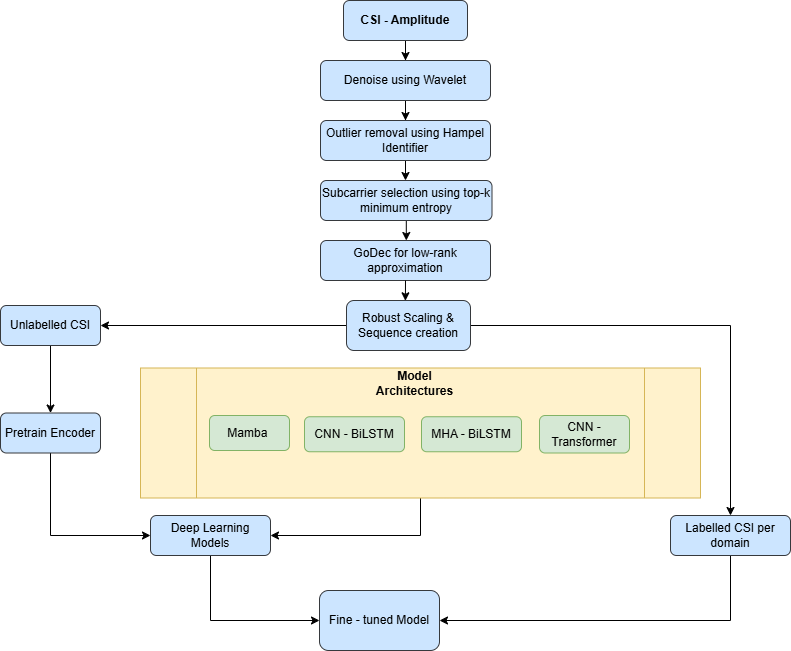
Raw Wi-Fi CSI data is inherently noisy due to hardware anomalies, environmental reflections, and multi-path fading. We engineered a robust processing and modeling pipeline in Python and TensorFlow/Keras to denoise signals and classify human actions accurately.
The preprocessing stage uses Wavelet transforms for high-frequency noise attenuation, the Hampel Identifier for outlier detection, top-k minimum entropy for selecting the most informative subcarriers, and GoDec low-rank approximation for signal decomposition prior to sequence formation.
Multi-Model Deep Learning Benchmarks
Implemented and evaluated CNN-BiLSTM, CNN-Transformer with Cross-Feature Attention, and Mamba state space models in Keras/TensorFlow to capture fine-grained temporal dynamics across core activities (walking, sitting, standing, lying).
The Cross-Environment Challenge
While models achieved strong accuracy on data from the environments they were trained on, testing on data collected in different physical rooms revealed performance drops. Generalization may requires auxiliary features encoding room layout directly from CSI.
03 / SYNTHESIS
How this informs my UX work
Although this was an AI and signal processing research project, the experience directly informs how I approach UX research, team collaboration, and structured problem-solving:
- Empirical Field Testing & Rigor: Setting up physical testbeds, managing on-field trials across participants, and navigating environmental variables directly parallels conducting contextual inquiries and usability testing in real-world environments.
- Collaborating & Navigating Ambiguity: Working with teammates under the guidance of a professor taught me how to navigate open-ended problem spaces, adapt to ambiguous project constraints, and align team efforts toward evolving milestones.
- Structured Documentation & Insight Synthesis: Rigorously tracking trial runs, logging experimental data across spreadsheets, and documenting nuances helped me develop a disciplined approach to synthesizing quantitative patterns and deriving actionable directions from findings.